What America spends on failing urban schools, who pays for empty buildings, and why money without accountability produces nothing but more expensive failure.
Read The Full Research — Free



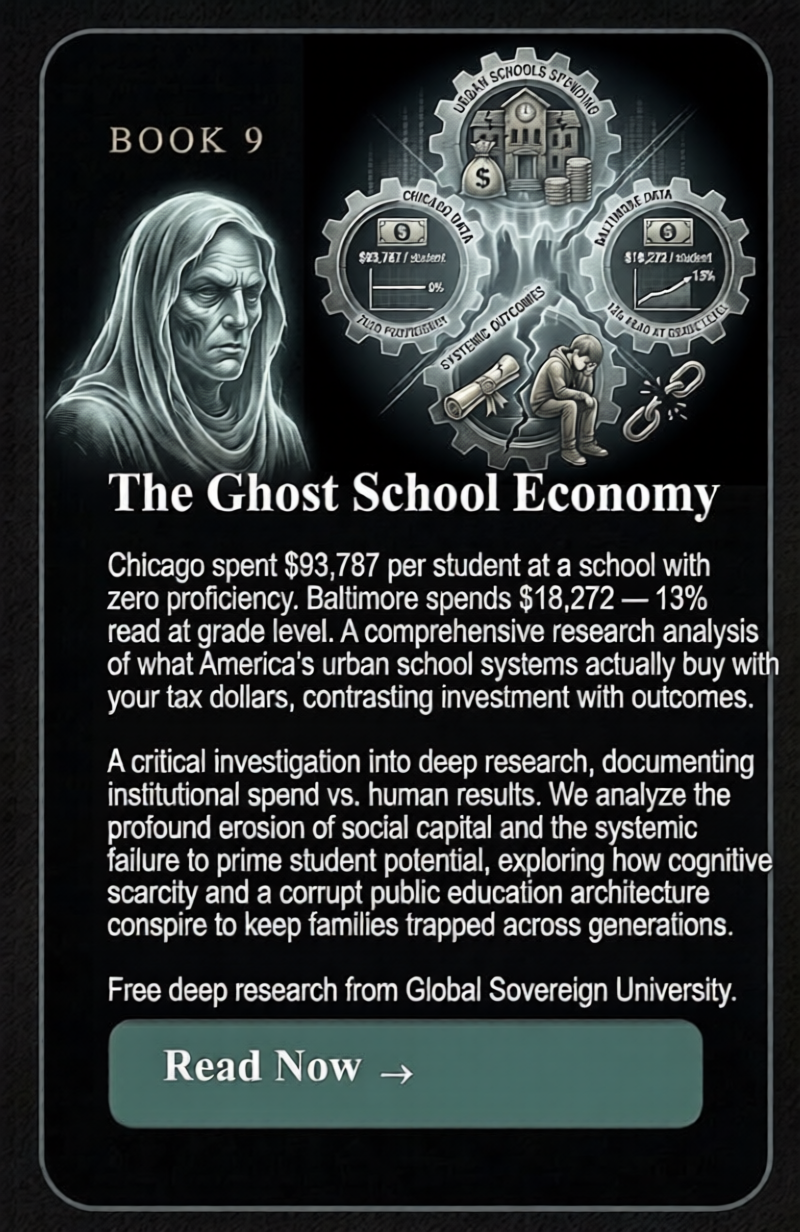
Frederick Douglass Academy High School on Chicago's West Side was built to educate more than 900 students. During the 2023–2024 school year, it enrolled between 27 and 35. It employed 28 full-time staff members — more staff than students. Per-pupil spending reached $93,787. That figure exceeds the total cost of attendance — tuition, room, and board — at the University of Chicago or Northwestern University.
The academic output of this $93,787-per-student investment: not one 11th-grade student demonstrated proficiency in math or reading on standardized assessments. Not one. Sixty-five percent of enrolled students were chronically absent — missing more than 10% of school days. More than half the teaching staff missed ten or more school days annually.
This is not a story about one bad school. It is a story about what happens when a system decouples spending from outcomes, insulates itself from accountability, and treats the building — and the staff positions inside it — as the product rather than the child.
| Fiscal Year | Student Enrollment | Per-Pupil Spending | Reading/Math Proficiency |
|---|---|---|---|
| FY 2019 | 61 | $34,361 | Near Zero |
| FY 2020 | 58 | $35,411 | Zero |
| FY 2021 | 49.5 | $42,538 | Zero |
| FY 2022 | 44 | $56,311 | Zero |
| FY 2023 | 30 | $68,091 | Zero |
| FY 2024 | 33 | $93,787 | Zero |
| FY 2025 (Proj.) | 28 | $54,695 | Zero |
Between FY2019 and FY2024, per-pupil spending at Douglass Academy rose 170% while enrollment fell 50%. The outcome at every point: zero proficiency.
Douglass Academy is not an outlier in Chicago — it is the logical endpoint of a district-wide pattern. Chicago Public Schools currently manages at least 255 underutilized school buildings, constituting more than half of its standalone public schools. Of these, 145 are more than half empty and 24 operate at vacancy rates exceeding 75%. The result is approximately 144,000 unused seats across the district — representing 32% of total capacity.
Since 2019, CPS enrollment has fallen 10%. Over the same period, district staffing has increased by 20% — the equivalent of 6,900 additional full-time employees added between 2014 and 2024. The 10 emptiest schools cost nearly double the district average per student. These two trends — shrinking student population, expanding labor force — are the direct arithmetic of the district's current $734 million budget deficit.
The academic consequences are distributed across the system, not confined to Douglass Academy. In 2024, 80 Chicago public schools reported zero students proficient in math. Twenty-four reported zero proficiency in reading. Seventy percent of third-graders in Illinois public schools cannot read at grade level — a figure that reflects not the failure of any individual school but the failure of an instructional philosophy applied at scale.
| Utilization Category | Number of Buildings | Share of District |
|---|---|---|
| Underutilized (less than 70% capacity) | 255–287 | 58% |
| Efficiently Used (70–80% capacity) | 185 | 37% |
| Overcrowded (above 80% capacity) | 24 | 5% |
The pattern documented in Chicago — escalating per-pupil expenditure alongside catastrophic stagnation in academic outcomes — is replicated across every major American urban district examined in this research. The specific numbers differ. The structural dynamic is identical.
| District | Per-Pupil Spending | Reading Proficiency | Math Proficiency |
|---|---|---|---|
| Chicago (Douglass) | $93,787 | 0% | 0% |
| Los Angeles (LAUSD) | $25,941 | 30.3% | 42% |
| Newark (NPS) | $24,281 | 34% | 21% |
| Baltimore (BCPS) | $18,272 | 13% | 15% |
| Detroit (DPSCD) | ~$18,000 | 13% | 12.3% |
The persistence of underutilized facilities and the continued funding of academically bankrupt institutions is not an accident of poor management. It is the predictable output of contract provisions that were specifically designed to prevent the adjustments a functioning market would automatically produce.
In Chicago, the Chicago Teachers Union successfully lobbied for a moratorium on school closures extending through the 2026–2027 academic year — passed unanimously by a Board of Education appointed by a mayor with deep institutional ties to the union. The American Federation of Teachers has issued national resolutions calling for moratoriums on mass school closings across the country. In Philadelphia, the Philadelphia Federation of Teachers has consistently blocked facilities master plans that would have consolidated half-empty buildings. In Oakland, union leaders negotiated a specific closure moratorium as a condition of ending a strike.
The mechanism these provisions create is what researchers describe as the ratchet effect. During periods of population growth or temporary fiscal surplus — such as the federal COVID-19 relief funds — districts expand their physical footprint and labor force. When student populations subsequently decline, union-negotiated moratoriums prevent the contraction of those costs. The fixed-cost denominator remains static while the student numerator shrinks. Per-pupil costs rise exponentially. The ghost school is the mathematical result.
The ideological argument against closures — that neighborhood schools have irreplaceable community value — is not without merit as a general principle. The problem is its application in cases like Douglass Academy, where the "neighborhood school" serves 27 students, employs more staff than it has students, and has produced zero academically proficient graduates for multiple consecutive years. At that point, the community value argument has been entirely consumed by institutional self-preservation.
A 2025 research review by EdChoice analyzed dozens of empirical studies on school choice programs and found that 84% showed positive effects on students, schools, or state budgets. Meta-analyses of private school choice programs indicate that voucher participants experience gains equivalent to approximately 30 additional days of learning per year. Long-term data shows higher high school graduation rates and college enrollment among choice participants.
The competitive effect on traditional public schools is documented, though more nuanced. Systematic reviews have found small but statistically significant positive impacts on student achievement in public schools located in areas with high charter school or voucher competition — effects most pronounced in high-poverty districts with high percentages of minority students. The evidence from Milwaukee — one of the longest-running voucher programs in the country — shows that competition elevated performance in both the private and public sectors.
The critical finding, however, is not about the relative performance of choice vs. traditional public schools. It is about what happens when institutional barriers prevent public school administrators from responding to competition. Instead of improving quality, many districts respond by seeking more funding to cover the rising per-pupil costs of their increasingly empty buildings. The ratchet effect absorbs the competitive pressure without producing the behavioral change the pressure was designed to generate.
| Choice Model | Research Finding | Effect |
|---|---|---|
| Private Vouchers | 84% of studies show positive outcomes | ~30 additional learning days per year |
| Charter Schools | Positive competitive effect on public schools | Strongest in urban/high-poverty areas |
| Education Savings Accounts | High parent satisfaction, focus on low-income | Funding follows the student, not the building |
Global Sovereign University was built as the structural opposite of everything this research documents. Every architectural decision GSU made — free access, no building overhead, AI-powered instruction, mastery-based progression — was made in direct response to the failure modes this report identifies.
The ghost school economy is built on fixed costs that cannot be reduced: buildings that must be heated, maintained, and staffed regardless of how many students show up. GSU carries none of those costs. The platform scales to one learner or one million at the same marginal cost. There are no empty hallways. There is no administrative bloat consuming the budget before it reaches instruction. There is no union moratorium preventing the elimination of programs that are not working.
The $93,787 that Chicago spent per student at Douglass Academy — producing zero proficiency — could fund free, AI-powered, personalized education for thousands of learners on the GSU platform. The comparison is not meant as self-promotion. It is meant as an illustration of what the research consistently shows: the problem in urban public education is not a shortage of money. It is a structural incapacity to direct money toward outcomes. That incapacity is built into the contracts, the moratoriums, the administrative overhead, and the political economy of a system that treats the institution as the product rather than the learner.
GSU's Amnesty Protocol — no past transcripts, no past grades, no judgment about where you are starting from — exists specifically for the students who passed through buildings like Douglass Academy and emerged without the foundational skills the system was paid to deliver. The system failed them. The money was spent. The bridge was never built.
We are building it now. Free. For everyone the system left behind.
Global Sovereign University is free. No tuition. No login. No record of the system that failed you. The Amnesty Protocol means you start where you are. The bridge is open — and it costs nothing.
CROSS THE BRIDGE →Nine peer-reviewed research reports — free, fully cited, written for anyone ready to understand why the world works the way it does.